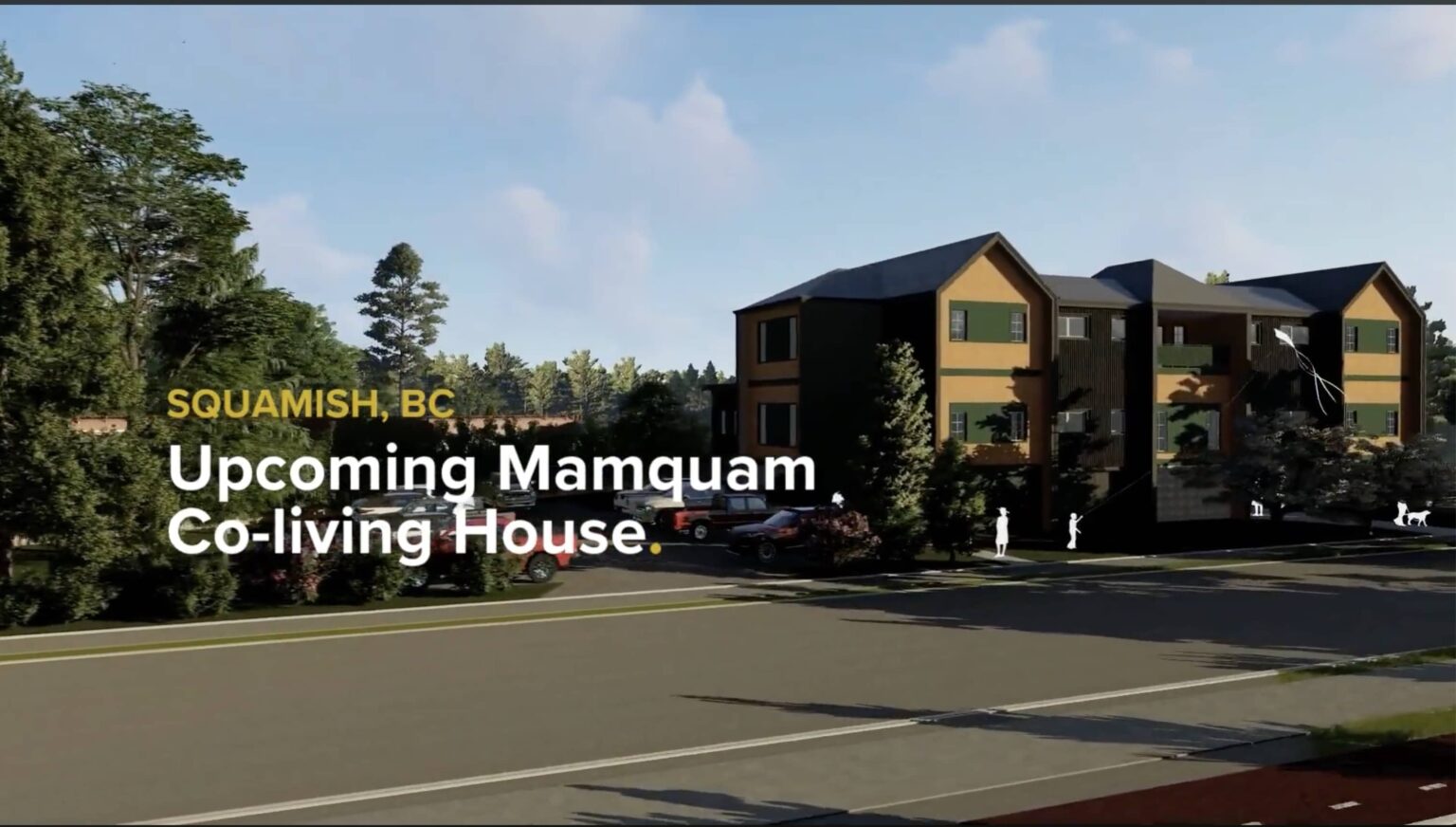
In January 2025, Responsible Living submitted a permit application for Mamquam House, a 30-resident co-living project in Squamish. The goal was straightforward: add more attainable, secure housing to a community where demand was already obvious. At the time of the March 6, 2026 call, the project still had not reached construction, despite extensive design work, financing efforts, repeated compliance adjustments, and two successful building code appeal outcomes. According to the call, the delay had already stretched beyond a year, added direct repeat costs of about $20,000, tied up capital for an extra year, and left 30 people unhoused despite a waitlist of roughly 200 people.
Watch the video of the upcoming Mamquam village
This is the story of that delay.
It is not a story about one disagreement or one isolated permit comment. It is a story about what happens when a project moves through planning, building, engineering, financing, and appeal processes, only to keep encountering new hurdles after prior hurdles have already been addressed. It is also a story about the gap between saying a community needs housing and actually creating the conditions to deliver it.
The project itself is not a speculative concept. Mamquam House was described in Responsible Living’s prior materials as a five-residence, 30-suite micro-community designed to respond to growing affordable housing demand in the Sea-to-Sky corridor. By March 2026, the design had already been completed and the team was working through final design refinements and financing steps to move the development toward construction.
From the beginning, the expectation was that the process, while demanding, was moving in a workable direction. On the call, Dave Ransier stated that the permit application was submitted on January 14, 2025, and that the team believed they would be picking up the building permit in summer 2025 after working through comments from planning and the building department.
At the same time, the financing side was also moving. Dave explained that while the permit process was underway, Responsible Living also pursued funding through multiple channels. One of those was a CMHC-backed path with People’s Trust, which had produced what he described as a solid commitment letter. During that same period, the team also opened discussions with BC Builds before accepting the People’s Trust commitment.
On paper, BC Builds looked better. According to the call, it required about 25% less equity than the CMHC offer and provided a better interest rate. Dave explained that this mattered because stronger financing terms would leave less capital tied up in one project and make it easier to move into future projects. The tradeoff was time: pursuing BC Builds was expected to create a three- to four-month delay. Even so, the team decided that the improved structure justified the wait.
That decision became the first major setback.
After about four months of working with BC Builds and providing extensive application materials, the loan amount was cut by about 25% because the rental income was from a co-living model rather than a conventional apartment format. Dave stated on the call that BC Builds later said this policy had been in place from the beginning of the program, yet it had not been disclosed upfront. The result was not just a weaker financing package. It meant the earlier CMHC / People’s Trust commitment expired, and the project had to start that financing process over again in September 2025.
That financing reset mattered because it overlapped with a second and even more serious challenge: the District’s treatment of the project under the building code.
Dave described the central issue plainly. The building department’s authorizing authority took the position that six unrelated people living together should not be treated as a dwelling unit or home. Instead, he considered it something more like a motel. According to the call, that interpretation triggered demands for commercial-level fire separations and compliance with a different part of the BC Building Code intended for larger commercial buildings. Dave said this would have increased costs dramatically, made the existing design impossible to build, and forced a full redesign.
That was not a minor design comment. It was a direct challenge to the viability of the project as designed.
A key date in this process came on June 19, 2025. Dave said a ruling issued on that date concluded that the project could qualify as a dwelling if it operated under a single tenancy rather than under separate agreements with each resident. In practical terms, that meant one agreement signed collectively, not multiple individual agreements. Responsible Living agreed to adapt the operational structure to meet that requirement. Dave stated on the call that they agreed to lease the buildings under a single tenancy specifically so the project would be code compliant.
That should have moved the process forward.
Instead, according to the call, sometime in August 2025 the same building official said he did not believe the project would actually be operated that way and still would not issue the building permit. Dave noted that he would need to go back through emails to identify the exact date, but the sequence was clear: even after adapting the project to align with the June 19 ruling, the permit still did not move.
That refusal forced Responsible Living to file a second BC building code appeal, which Dave said was submitted in December 2025. The board then adjudicated that appeal and, on January 26, 2026, ruled that the buildings as designed were code compliant if operated under a single lease. By that point, according to the call, the building department had effectively lost two appeal board decisions on the issue.
Even then, the process did not simply resolve.
After the January 26, 2026 ruling, Dave said the team received an email stating that a restrictive covenant would now need to be registered before the building permit would be issued. This was a major point in the call because Dave distinguished sharply between planning and building authority. He said the planning director had already provided written confirmation that the project conformed to zoning, meaning the issue was not a zoning issue. He also said the District had already provided comfort that the co-living dwellings conformed to zoning for the relevant properties. In his view, that meant the matter remained a building permit issue, not a land-use issue.
This distinction matters because it shows where the friction actually sat. According to the call, planning had effectively confirmed compliance on the zoning side, while the building process kept introducing new obstacles tied to future-use concerns rather than current code compliance. Dave described the underlying concern of the building official as worry about how the buildings might be used in the long run, decades from now, if a future owner operated them differently. He described this as a form of blame avoidance: concern that if future operators used the homes in a way that created neighbourhood issues, someone might later ask why permits had been issued for that kind of house.
Whether that concern was understandable or not, the effect was concrete: the project stayed stuck.
The financial effect of that delay was laid out directly in the call. Dave said the delay had pushed the project back by over a year and that, by then, they should have had 30 people on their 200-person waitlist affordably and securely housed. On the direct-cost side, he listed the second CMHC application, a second budget review, a new appraisal, and supporting documents, which together added up to about $20,000. He then added that this did not include the time costs for staff and consultants.
He also described the broader cost of delay in larger terms. Referring to a UDI estimate that each month of delay adds a cost per square foot to a building, he applied that rough logic to a 9,000-square-foot project and said that even at the low end the delay had likely added a couple hundred thousand dollars to the project’s cost. In the call, he also noted that he still needed to look up the exact report before quoting it publicly, so that figure should be understood as the estimate discussed in the meeting rather than a verified published number within the transcript itself.
There was another source of delay that illustrates the broader municipal problem. Dave said that after applying on January 14, 2025, and after receiving comments from planning and the building department, the team expected to be close to permit issuance in the summer. But then, according to the call, the engineering department came forward with a list of requirements on October 18, 2025 — roughly nine months later. Dave cited this as an example of the uncertainty developers face when they do not know their costs and do not receive feedback in a reasonable timeframe.
That point is worth sitting with for a moment. This was not simply a matter of one no. It was a rolling sequence of delay:
- permit application filed in January 2025,
- expectation of a summer 2025 permit,
- financing paused for a better capital structure,
- that financing path later cut back,
- original financing expired,
- code interpretation changed the project’s classification,
- the team adapted to the June 19 ruling,
- permit still withheld,
- a second appeal filed,
- engineering requirements arrived in October,
- financing had to be rebuilt,
- the second appeal succeeded in January 2026,
- then a restrictive covenant was added as another condition.
Each of those steps required time, professional work, and cash. Each also postponed housing that the market had already shown it needed.
By the date of the March 6, 2026 call, the project was still alive and moving. Dave said the CMHC financing application had been submitted and they were waiting for CMHC to assign an underwriter, which he expected within about a month. On the design side, he said final drawings adjusted to planning and building department comments were expected to be submitted before the end of March. Because the plans had already been reviewed in depth, he said it was reasonable to expect a permit within four to six weeks of that final submission.
So this is not a story about abandonment. It is a story about persistence.
Responsible Living kept adapting the project to comply, kept updating reports, kept reapplying for financing, kept moving through appeal processes, and kept working to bring the homes to market. That is the part often missing from abstract conversations about housing. From the outside, a delayed project can look as if it simply “takes time.” From the inside, delay means redesign risk, consultant re-engagement, duplicated documentation, capital trapped for longer than planned, and real people still waiting for housing.
The larger lesson from this timeline is not that regulation should disappear. It is that process needs clarity, timeliness, and limits. If a project can adjust to a ruling, win an appeal, confirm zoning compliance, and still keep hitting new barriers, then the system is no longer simply reviewing a proposal. It is extending uncertainty.
And uncertainty has a cost.
For Squamish, that cost is not theoretical. It is 30 residents who could already be housed. It is a local project designed for the community still fighting through procedural obstacles more than a year after the permit application went in. It is repeated spending on applications, appraisals, cost reviews, and supporting documents. It is momentum lost to delay when the need for housing is already plain.
That is the real story here.
A needed housing project was proposed. It entered the system. It adapted, appealed, complied, reapplied, and kept moving. Yet more than a year later, it was still not built. If communities want more attainable housing, that gap between approval culture and actual delivery needs to be confronted directly. In Squamish, this project shows exactly what that gap can cost.